A Galápagos diving expedition presents experienced divers with a straightforward question: When do you dive, at which site — and with whom? The answers determine whether you’ll witness a school of hammerheads from mere feet away or spend most of your time managing powerful currents. Galápagos concentrates within 17,400 sq mi (45,000 km²) of marine reserve what elsewhere is scattered across thousands of nautical miles: whale sharks, hammerheads, mantas, sea turtles, sea lion colonies, and the complete pelagic spectrum of the Pacific — all in one location. This guide summarizes what you need to know before booking: dive sites by priority, conditions by season, and the questions no travel catalog answers. For a comprehensive overview of activities throughout the islands, visit our page on Galápagos Activities.
Why Galápagos Forms Its Own Category for Divers
The archipelago sits at the convergence of three ocean currents: the Humboldt Current from the south, the Cromwell Undercurrent from the west, and the warm Panama Current from the north. This convergence drives nutrient-rich deep water to the surface — the foundation for marine diversity fundamentally different from the tropical coral reefs where most diving occurs. What this means for divers: no pastel coral gardens, but open ocean with large animals. Visibility of 33 to 82 ft (10 to 25 m), currents that demand respect, and a density of pelagic species that established the Galápagos Islands’ reputation among divers worldwide.
The Essential Galápagos Dive Sites — Prioritized
Not every site suits every diver equally. The following overview distinguishes between sites accessible only by liveaboard and those reachable on day trips.
Darwin and Wolf — Hammerheads and Whale Sharks in Their Territory
Darwin and Wolf lie approximately 124 mi (200 km) northwest of the main archipelago. They’re accessible exclusively by liveaboard — a crossing of at least 16 hours from Santa Cruz. Darwin’s Arch ranks among the few locations worldwide where whale sharks appear regularly and in groups: between June and December, up to 30 individuals per dive. Hammerhead schools numbering in the hundreds are equally common from July through September.
Currents at Darwin and Wolf are strong and variable. These sites are unsuitable for divers without experience in open-ocean drift diving. Recommended minimum certification: Advanced Open Water, supplemented by Nitrox certification due to depth limitations on repetitive dives.
Note: Darwin’s Arch — a natural rock formation above the waterline — collapsed on May 17, 2021. The dive site remains intact: underwater rock formations are unchanged, current patterns unaffected.
Gordon Rocks — Dramatic Topography, High Current Density
Gordon Rocks, 45 minutes by speedboat from Santa Cruz, is an eroded crater wall enclosed by circular currents. Hammerheads, Galápagos sharks, eagle rays, and occasional reef sharks inhabit this contained biotope. The current rotates; there’s no predictable entry point — every dive here is fundamentally a drift dive.
Day trips from Santa Cruz are possible, making Gordon Rocks the most compelling site for divers not planning a multi-day Galápagos dive safari but still seeking large marine life. Depth: 16 to 105 ft (5 to 32 m). Visibility: 33 to 66 ft (10 to 20 m) depending on season. Not suitable for divers with fewer than 50 logged dives in current.
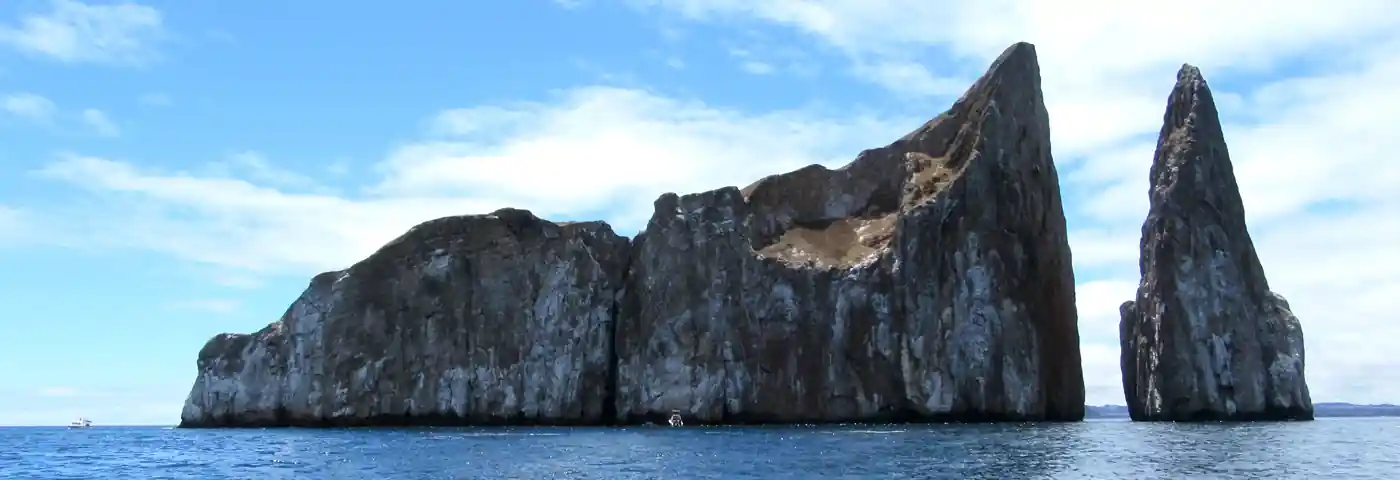
Kicker Rock (León Dormido) — Accessible and Species-Rich
Kicker Rock lies off San Cristóbal and is accessible on day trips from Puerto Baquerizo Moreno. The two rock pinnacles rising from the ocean enclose a narrow channel — the actual dive experience. Whitetip reef sharks rest regularly on the sandy bottom. Sea turtles, sea lions, and Galápagos penguins — one of the few locations where penguins can be observed underwater — make this site attractive even for divers seeking easier conditions.
Current is moderate. Depth: to 82 ft (25 m). Kicker Rock suits experienced divers of all levels and represents a solid option at the beginning or end of a liveaboard expedition.
North Seymour, Mosquera, and Floreana — Relaxed Reef Diving
North Seymour and the Mosquera sandbar offer manta rays, Galápagos sharks, and stingrays in manageable depths to 59 ft (18 m). Floreana lies in the southern archipelago and is known for black coral formations and high turtle density. These sites serve as counterbalance to more demanding spots — less current, calmer water, longer dive times.

Diving with Galápagos Hammerheads — Where, When, and What to Realistically Expect
Hammerhead encounters in the Galápagos Islands are documented and predictable — but not guaranteed. School behavior follows current lines, not the calendar. What significantly increases probability:
- Time window: July through October, when the Humboldt Current drives cool, nutrient-rich water northward.
- Depth: Schools frequently hold between 49 and 98 ft (15 and 30 m); individual specimens also appear in shallow zones.
- Behavior: Schooling hammerheads show no aggressive behavior toward divers unless provoked — which in Galápagos is strictly controlled by the Galápagos National Park Service (GNPS).
- Current dependency: Darwin and Wolf deliver the highest encounter rate; Gordon Rocks is the most accessible site with reliable sightings.
A Galápagos dive safari including Darwin and Wolf maximizes probability, as these sites are accessible exclusively by liveaboard and schedules adapt flexibly to dive conditions.
Travel Timing and Dive Conditions in Galápagos
Cool Season: June through November
The Humboldt Current brings colder water (64 to 73°F / 18 to 23°C), reduced surface temperatures, and elevated nutrient concentration. The result: higher density of pelagic species, including whale sharks and record-size hammerhead schools. Visibility of 49 to 82 ft (15 to 25 m) is standard during this season. Recommendation for diving Darwin and Wolf: July through October.
On deck, the chill is noticeable — a 5mm wetsuit is standard; for morning dives at Darwin, experienced guides recommend a 7mm suit or undergarment.
Warm Season: December through May
The Panama Current warms water to 75 to 81°F (24 to 27°C). Conditions are calmer, swells lower, making liveaboard transfers more comfortable. Visibility may decrease (33 to 59 ft / 10 to 18 m) as warming reduces nutrient concentration. In exchange, manta ray and turtle activity increases. A 3mm suit suffices at most sites during this season.

Darwin and Wolf Dive Sites — What Distinguishes Them from All Others
Darwin’s Arch and the surrounding sites at Wolf Island form a continuous territory that has served as the reference for pelagic diving since the 1990s. What distinguishes it isn’t depth — many dives begin at 16 to 26 ft (5 to 8 m) in the current zone — but the concentration of different species in layers from surface to 98 ft (30 m).
Booking a Galápagos dive safari with a Darwin/Wolf route requires advance planning: liveaboard capacity for this route is limited and books early, especially July through September. Bookings nine to twelve months ahead are realistic for this season.
Booking a Galápagos Dive Safari — What Actually Matters
Liveaboard or Day Trip?
Day-trip diving from Santa Cruz or San Cristóbal covers Gordon Rocks, Kicker Rock, North Seymour, and Mosquera. Darwin and Wolf are accessible exclusively by liveaboard. Anyone planning a complete Galápagos diving expedition who doesn’t want to skip the northern sites has no alternative. For a comprehensive overview of travel options throughout the archipelago, visit our page on Galápagos Cruises.
Liveaboard expeditions typically run seven or eight nights; shorter options (four to five nights) usually cover only central sites. The decision depends on target profile: hammerheads and whale sharks argue for the extended itinerary with Darwin/Wolf.
What Defines a Quality Dive Vessel
For experienced divers over 50, comfort and medical preparedness aren’t secondary considerations. The following factors are decisive in vessel selection:
- Cabin size and privacy: Liveaboards vary considerably — from budget category with bunk beds to luxury dive cruises. There’s something for everyone.
- Onboard oxygen supply: Mandatory for every reputable Galápagos operator; when in doubt, inquire before booking.
- Nitrox availability: Compressor and Nitrox analysis equipment enable longer bottom times with reduced decompression stress — a measurable difference over multiple daily dives across a week.
- Guide certification: GNPS-licensed dive guides are required. Reputable operators will name crew qualifications upon request.
Safety and Medical Preparation
The nearest decompression chamber is in Quito. On a liveaboard with three to four daily dives over seven days, this isn’t an insignificant factor. Recommendations for experienced divers over 50:
- Current dive medical clearance (physician examination, no older than 12 months)
- DAN insurance or equivalent with liveaboard coverage
- Nitrox certification, if available — enables longer dive times with lower nitrogen partial pressure
- Conservative dive profile: In Galápagos, it’s current, not depth, that controls the dive; maintain limits even when visibility tempts

Galápagos Diving After 50: Comfort and Safety Without Compromise
For divers in the second half of life, Galápagos isn’t necessarily more demanding than other dive destinations — provided vessel selection is appropriate and dive profile fits. The most common mistakes: too many dives on consecutive days without adequate nitrogen off-gassing, overestimated cold tolerance, and underestimated overnight crossings, which in swells can be considerably taxing.
What concretely improves the experience: a liveaboard with comfortable/low-profile berths, a dive guide who analyzes your personal dive log before the expedition begins, and an itinerary that deliberately avoids deep dives below 82 ft (25 m) — because the overwhelming majority of spectacular life in Galápagos moves between 16 and 66 ft (5 and 20 m).
Soleq Travel plans Galápagos dive safaris individually: route selection, vessel category, and time windows are determined collaboratively, not selected from a catalog.
Frequently Asked Questions About Galápagos Diving Expeditions
What certification is the minimum requirement for a Galápagos dive safari?
Open Water suffices for most sites. Darwin and Wolf de facto require Advanced Open Water — not formally, but current conditions make less experienced divers a safety risk to the group. Nitrox is recommended for anyone planning more than two dives per day.
How far in advance must I book a liveaboard for Darwin and Wolf?
For high season (July through October), quality vessels book nine to twelve months ahead. Bookings under six months before departure are possible but significantly reduce selection.
Are whale sharks visible year-round?
No. The most reliable encounter window is June through December, with a peak between August and November. During warm season (January through May), individual sightings are possible but not predictable.
Can I experience Galápagos diving without a liveaboard?
Yes. Day-trip diving from Santa Cruz or San Cristóbal provides access to Gordon Rocks, Kicker Rock, and central sites. Darwin and Wolf are excluded.
What does a Galápagos dive safari cost?
Liveaboard rates for seven nights with Darwin/Wolf routing range from $3,800 to $7,600 per person, depending on vessel category and season. This typically includes dive equipment, Nitrox (depending on operator), full board, and dive tours with certified dive master.
Planning Means Knowing What You're Diving For
A Galápagos diving expedition requires the right questions before booking: Which sites match your experience level? Which time window maximizes encounter probability for the species that interest you? And which vessel delivers conditions under which diving remains enjoyable after seven days?
Since 2006, Soleq Travel has planned and organized individually tailored expeditions to the Galápagos archipelago. No standard programs — but itineraries that consider your dive log, your priorities, and your physical requirements.
If you have specific questions about Galápagos dive safaris or the optimal time window for your expedition, speak with us — not with a form, but with an advisor who knows the islands personally.
Request Galápagos Diving Expedition →
Venture. Discover. Marvel.